
3 Best Drip Irrigation Filter-Regulator Kits Australia – Cleaner Lines, Consistent Pressure
Clogged emitters after a dusty northerly or poly lines popping off on hot afternoons usually trace back to two things: dirty water and unstable pressure. A proper filter–regulator kit at each drip zone fixes both, protecting your drippers and keeping flow even across long runs. For whole‑yard upgrades and automation ideas, see Complete Irrigation Automation for Australia and Perth Reticulation Upgrade: Drip Zones.
Quick Picks
- Best Overall: 3/4" BSP Y‑filter + fixed 25 psi regulator kit – reliable with most Aussie drip lines; easy to flush and service.
- Best Budget: Compact inline filter + 20–25 psi regulator kit – tidy head for small beds, patio pots and short hedge runs.
- Best Premium: High‑flow 1" assembly with disc filter + adjustable regulator – for long hedges, multiple branches and pump/tank setups.

Drip Irrigation Pressure Regulator And Filter Kit, 25 Psi Water Flow Controller With Backflow Preventer For Garden Hoses, Spigots And Sprinkler Manifolds
$13 on Amazon
3/4 Inch Drip Irrigation Pressure Regulator And Filter Kit | 25 PSI Adjustable Water Reducer With Backflow Preventer For For Garden Hose Spigot, Soaker Hose
$10.2 on Amazon
Rain Bird RBY100S Drip Irrigation in-Line Y Filter, 1" x 1" Male Thread
$26.96 on AmazonWhy filter–regulator kits matter in Australian gardens
Town mains in AU can swing from high morning pressure to sagging flow by late afternoon. Bore and tank water often carry grit, iron and biofilm that block 2 L/h emitters. A head assembly with the right mesh rating and a pressure regulator matched to your emitters (usually 15–30 psi) keeps output consistent and saves water. If you’re building smart zones, pair these heads with a controller from our guide to Smart Sprinkler Controllers or go drip‑specific with Smart Drip for Hedges.
Best Overall – 3/4" BSP Y‑filter + 25 psi regulator kit
Why it stands out
It hits the sweet spot for most suburban installs: a serviceable Y‑filter (typically 120–155 mesh) that catches fine grit, plus a fixed 25 psi regulator that suits common pressure‑compensating drippers and micro sprays. The Y‑body makes flushing fast, and 3/4" BSP threading plays nicely with Australian fittings.
Real‑world use case
Retrofitting a 20–35 m hedge in Sydney on mains water with 2 L/h PC drippers at 30 cm spacing. After adding this kit at the valve, end‑of‑line flow matched the first 5 metres, and weekly emitter clogs disappeared.
Pros
- Balanced pressure for most drippers and micros.
- Y‑filter simplifies maintenance and pre‑season flushes.
- BSP threads suit AU adaptors and solenoids.
Cons
- Fixed 25 psi isn’t ideal if you run foggers/misters needing 40+ psi upstream.
- Not the best choice for very silty bore water without extra filtration.
Best for
Standard garden beds, hedges and veggie rows on town water; most 13 mm poly drip layouts up to moderate lengths.
Who should avoid
Users on sandy bores or tanks with visible sediment (consider a disc filter or larger body) and those needing adjustable pressure for mixed emitters.
Best Budget – Compact inline filter + 20–25 psi regulator kit
Why it stands out
A tidy, lightweight assembly that slots neatly into small valve boxes or connects at a tap timer. Fewer parts, fewer leaks, and still enough filtration for clean mains water.
Real‑world use case
Raised beds in Melbourne fed from a Wi‑Fi tap timer. Short runs, 2–3 beds, quick seasonal set‑up/pack‑down. This compact kit kept fittings minimal and pressure stable without over‑engineering.
Pros
- Low cost and simple to install.
- Great for short, low‑flow zones and renters.
- Works well on clean scheme water.
Cons
- Smaller filter area needs more frequent cleaning.
- Lower flow capacity; not ideal for long hedges or branching manifolds.
Best for
Patio pots, compact veggie beds, balcony gardens and small side‑yard hedges.
Who should avoid
Anyone on bore/tank water or feeding multiple sub‑zones; step up to a larger Y or disc filter assembly.
Best Premium – High‑flow disc filter + adjustable regulator head
Why it stands out
Disc filters trap fine sediment and biofilm better than simple screens and withstand frequent cleaning. Pairing with an adjustable regulator (e.g., 15–50 psi) lets you tune pressure for long runs, slopes, or mixed emitters without re‑plumbing.
Real‑world use case
Gold Coast property running a rainwater tank and pressure pump across 50+ metres of drip under tropical borders. Adjustable regulation eliminated zone‑start hammer and balanced output along a sloping line.
Pros
- Higher flow capacity for long or branched zones.
- Disc stack handles fine silt, algae and iron slime better.
- Adjustable pressure accommodates future changes.
Cons
- Higher upfront cost and slightly larger footprint.
- Adjustment range requires a pressure gauge to set accurately.
Best for
Large landscapes, tank/pump systems, and mixed micro irrigation where future expansion is likely.
Who should avoid
Simple, single‑bed installs on clean mains water; you won’t use the added capability.
Comparison at a glance
| Product type | Best use case | Main advantage | Main limitation |
|---|---|---|---|
| 3/4" Y‑filter + fixed 25 psi | Typical hedges and beds on mains water | Easy flushing, AU‑friendly threads, set‑and‑forget | Not adjustable for special emitters |
| Compact inline + 20–25 psi | Small beds, pots, renters, tap‑timer setups | Low cost, small footprint | Lower flow, more frequent cleaning |
| Disc filter + adjustable regulator | Long runs, pumps/tanks, mixed emitters | High flow, fine filtration, tunable | Costs more and needs gauge to dial in |
How to choose the right kit for Australian conditions
Match pressure to emitters
- Most pressure‑compensating (PC) drippers: 20–30 psi (25 psi is the safe default).
- Micro‑sprays/fan jets: often happier at 20–25 psi to avoid misting.
- Foggers/misters: may want 40+ psi upstream; regulate per branch if mixing devices.
Pick the right filter media
- Screen (e.g., 120–155 mesh): fine for clean mains; quick visual checks.
- Disc: better for bore/tank sediment, iron and organics; cleans thoroughly.
Mind your threads and fittings
Australia uses BSP threads. Most garden/tap and solenoid fittings are 3/4" BSP; larger setups may be 1". If you’re connecting at a tap timer, use a backflow device first, then filter → regulator → adaptor into 13 mm poly. For manifolded systems, install the kit after each valve so zones regulate independently. Building a bigger retrofit? See Whole‑Yard Reticulation Retrofit.
Flow capacity matters
Undersizing the head assembly starves the far end of your line. If your zone pushes 400–800 L/h (common on long hedges), choose a kit rated to exceed that flow with minimal loss. Adjustable regulators and 1" bodies provide more headroom.
Installation tips that prevent call‑backs
- Backflow first: Use a vacuum breaker or approved device at the source.
- Direction arrows: Filters/regulators are directional—install correctly.
- Add a flush point: A cap or auto‑flush on the filter body purges debris at start‑up.
- Use thread sealant rated for potable water; avoid over‑taping BSP threads.
- Include a pressure gauge port when using adjustable regulators.
For tanks and pumps, consider pressure control and flow monitoring from our guides to Rainwater Tank Irrigation Automation and Irrigation Flow Meters & Leak Detection.
Recommended add‑ons (small but valuable)
- 120–155 mesh Y or disc filter for bore/tank water

ZONADA 3/4 Inch Mesh Screen Filter Y-Shaped Garden Water Filter Irrigation Strainer Filter Gardening Agriculture Filter Drip Irrigation
$17.99 on Amazon - Inline pressure gauge to set adjustable regulators accurately

MEASUREMAN 2-1/2" Water Pressure Test Gauge, 3/4" Female Hose Thread, 0-200 psi/kpa
$30.25 on Amazon - Automatic flush valve to purge debris at start‑up
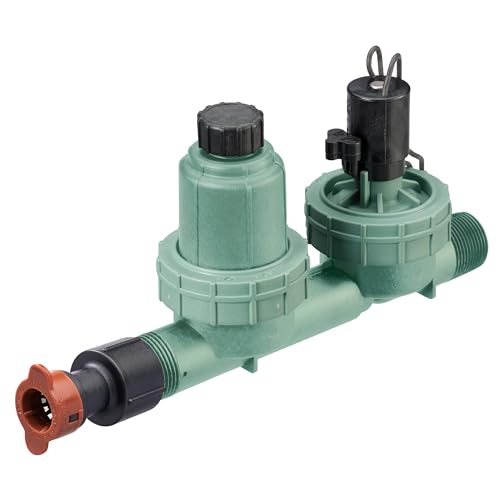
Orbit DripMaster 67790 4-in-1 Drip Irrigation Valve
$62.06 on Amazon
Planning subsurface drip for turf or long garden runs? Read Subsurface Drip for Lawns and pair your head assemblies with a smart controller from 24VAC Smart Controllers.
FAQ – Filter‑regulator kits in Australia
What pressure should I regulate to for drip irrigation?
Most pressure‑compensating drippers work best around 25 psi (about 170 kPa). Micro‑sprays often like 20–25 psi. Check your emitter spec and set the regulator accordingly.
Screen or disc filter for Australian bore water?
Disc filters handle fine silt, iron and organic slime better and are easier to clean thoroughly. Use a disc body if you’re on bore or tank water, or add a larger pre‑filter upstream.
Do I need backflow prevention on a garden tap?
Yes. Australian plumbing codes require backflow prevention to protect potable water. Use an appropriate vacuum breaker or the device specified by your local authority at the water source.
Where should the filter–regulator go in the system?
Install the filter before the regulator and after any backflow device. On multi‑zone systems, place a filter–regulator on each zone downstream of its valve so every zone gets correct pressure.
Will a filter–regulator reduce my flow too much?
Only if undersized. Choose a body and regulator rated above your zone’s maximum flow. For long hedges or branched manifolds, step up to larger assemblies.
How often should I clean the filter?
On mains water, inspect each season and after line repairs. On bore/tank water, check after the first few runs, then set a cleaning schedule based on what you see in the screen/disc stack.
Can I use these kits with a rainwater tank and pump?
Absolutely. They protect drippers from tank debris and stabilise pressure. For variable‑speed or high‑head pumps, adjustable regulators plus a gauge make dial‑in easy.
Are 3/4" BSP kits compatible with 13 mm poly?
Yes. Use a 3/4" BSP to 13 mm barbed adaptor (or compression fitting) after the regulator to step down into your poly laterals.
Do I need to winterise in Australia?
In most regions, no full winterisation is required. Still, flush lines pre‑winter and after summer dust events; in frost‑prone zones, ensure components can drain.
The practical upgrade path
Start with a correctly sized filter–regulator per zone. As your garden grows, add: a master filter at the main, a flow meter for leak alerts, and a smart controller with seasonal adjustments. When you branch into misters or long slopes, move to adjustable regulation. For raised‑bed growers, see Raised Bed Drip Kits and moisture automation options in Soil Moisture Sensors.