
3 Best Walk‑Behind Lawn Spreaders Australia – Even Coverage for 400–1000m²
Patchy feed, burnt strips and wasted product usually trace back to a flimsy spreader. On 400–1000m² Aussie blocks, a solid walk‑behind unit is the difference between a streaky lawn and a dense, even green. If you’re planning a spring feed, pre‑emergent pass or overseeding as part of a lawn renovation, pair the right spreader with a simple soil test and your results jump fast.
Quick Picks
- Best Overall: Earthway commercial walk‑behind – Accurate metering, enclosed gearbox, pneumatic tyres; perfect rhythm and control on 400–1000m².
- Best Budget: Scotts broadcast spreader – Simple setup, EdgeGuard‑style border control; light, quick, and ideal for 400–600m² (or 800m² with a refill).
- Best Premium: Agri‑Fab heavy‑duty push – Bigger hopper and wider pattern cuts passes on 800–1000m²+, built to last.

Earthway 2150 50 LB (22 KG) Commercial Broadcast Fertilizer Spreader. Red, Heavy-Duty Walk-Behind Push Garden Seeder with Adjustable Drop Rate and Driving Handle. Large 13 in Pneumatic Stud Tires
$593.32 on Amazon
Scotts Handy Green Fertilizer Spreader
$31.58 on Amazon
50lb Push Spreader
$118.47 on AmazonChoosing a walk‑behind spreader for 400–1000m² in Australia
Capacity that matches your block
Most 400–1000m² lawns need a 20–35 L hopper to avoid constant refills. Too small and you’ll chase your tail; too large and you add push weight without benefit. A practical rule: aim for 1–2 fills per application across your total area.
Spread pattern and control
Broadcast (rotary) spreaders suit Aussie lawns best because they throw granules in a wide, even fan. Look for a side deflector or border control to avoid feeding paths and driveways. A smooth, enclosed gearbox maintains consistent throw and protects from fertiliser dust and coast‑air corrosion.
Tyres and chassis matter on buffalo and kikuyu
Buffalo and kikuyu thatch can be spongy. Pneumatic tyres roll true, don’t skip, and keep granules fanning evenly. A rigid, corrosion‑resistant frame (stainless fasteners are a plus) keeps the gate alignment locked in.
Calibration and gate feel
A precise, repeatable gate is what separates a weekend gadget from a proper tool. You want micro‑adjustment and a positive shut‑off that doesn’t dribble when you stop at the end of a run.
Who each spreader suits (quick comparison)
| Product | Best use case | Main advantage | Main limitation |
|---|---|---|---|
| Earthway commercial walk‑behind | Accurate fertiliser and pre‑emergent on 400–1000m² | Consistent pattern, stable chassis, enclosed gearbox | Heavier than plastic budget units |
| Scotts broadcast spreader | Fast feeds on small–medium yards (400–700m²) | Light, quick to assemble, border control | Plastic gearing, narrower wheels, more refills |
| Agri‑Fab heavy‑duty push | Fewer passes on 800–1200m², rougher ground | Larger hopper, wide throw, stout frame | Bigger footprint for storage; needs steady pace |
Earthway commercial walk‑behind – Best Overall
Why it stands out: Earthway’s commercial push spreaders feel planted. The combination of pneumatic tyres, a stiff handle set and an enclosed gearbox gives you a consistent fan even over lumpy buffalo. The gate lever has a tactile, repeatable action, so your second pass matches your first. Optional side‑deflector kits make edging tidy around paths and driveways.
Real‑world use case: If you’re laying down a pre‑emergent in early spring and a slow‑release fertiliser six weeks later, this unit keeps rates tight across multiple products without constant re‑tweaking. It’s also forgiving when you hit a patch of thatchy kikuyu or a shallow dip.
- Pros: Stable stance; even fan; good corrosion resistance; easy to keep calibrated.
- Cons: Heavier than plastic options; costs more up front.
Best for: Homeowners who want professional‑level consistency on 400–1000m² and plan multiple granular passes per year.
Who should avoid: If you only feed once a year on a tiny courtyard, a lighter budget unit is simpler.
Scotts broadcast spreader – Best Budget
Why it stands out: Simple assembly, clear settings, and a border/edge mode make Scotts’ push spreaders friendly if you’re upgrading from a hand shaker. The light chassis is easy to manoeuvre around garden beds and stepping stones.
Real‑world use case: A typical 500m² suburban lawn: one quick pass with a slow‑release, pop the hopper off for storage, and you’re done. If you’re feeding 800–900m², plan on one refill to keep the pace steady and coverage even.
- Pros: Affordable; fast to get rolling; border control reduces overspread on hardscapes.
- Cons: Plastic gears can wear if overloaded; narrow wheels can skip on soft thatch; not as precise at very low rates.
Best for: First‑time buyers and smaller lawns that still need a proper broadcast fan.
Who should avoid: Renovators chasing tight, repeatable rates for pre‑emergents on bigger areas should step up to a commercial chassis.
Agri‑Fab heavy‑duty push – Best Premium
Why it stands out: Built to cover ground quickly, Agri‑Fab’s heavy‑duty push spreaders combine a larger hopper with a broad, even throw. The frame feels stout, and sealed gearboxes shrug off dust and granular fines common with coated fertilisers.
Real‑world use case: If your lawn pushes beyond 900–1000m² or includes a verge and nature strip, the extra capacity reduces refills and helps keep a steady walking rhythm—key to uniform colour.
- Pros: Bigger hopper reduces downtime; wide, consistent pattern; handles rougher patches better than light plastic frames.
- Cons: Needs more storage space; heavier to lift; overkill for small blocks.
Best for: Larger Aussie yards or anyone who wants fewer passes per application.
Who should avoid: If you have tight shed space or many narrow paths, a mid‑size chassis is easier to live with.
Set‑up, calibration and application on Aussie lawns
Different granules flow differently. That’s why a quick calibration saves money and stops stripes:
- 1. Weigh and mark: Measure 100m² on the lawn. Weigh the product needed for that area (label rate × 100m²).
- 2. Start conservative: Set the gate smaller than you think. Walk at your natural pace and make one pass.
- 3. Check leftover: You should have 10–20% product left. Open slightly and repeat next time if needed.
- 4. Two‑pass method: Half‑rate north–south, half‑rate east–west. This evens out any overlap and fixes most beginner striping.
- 5. Edge last: Use a border/deflector pass to tidy edges without feeding hard surfaces.
Two small add‑ons that make life easier:
- Use a marking dye to see where you’ve been on warm‑season lawns.

4X Red Concentrated Spray Pattern Indicator Dye - Fertilizer Marking for Lawn Turf, Easily Mark Where You've Sprayed, Safe & Non-Staining 1 Gallon
$165.89 on Amazon- Grab a simple test kit to dial in NPK needs and avoid over‑applying.

Soil pH Test Kit,150 Test Strips(3.5-9 Range) for Testing Garden
$16.99 on Amazon- If your unit lives in the shed near the coast, a rain cover helps keep granules dry between refills.
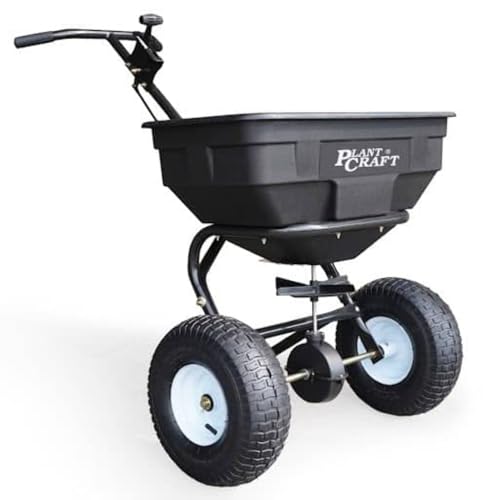
PlantCraft 56kg Walk-Behind Broadcast Spreader
$233 on AmazonWhat to add next (simple upgrade paths)
- Battery scarifier/dethatcher before feeding helps granules reach the soil in thick buffalo and kikuyu.
- Rolling spike aerator opens the surface for better nutrient and water movement.
- Leveling rake/drag mat makes seed and topdress work more uniform if you’re renovating.
- Planning a bigger overhaul? See our Aussie lawn renovation system guide.
FAQs
Broadcast or drop spreader for Australian lawns?
Broadcast (rotary) spreaders suit most Aussie lawns because they cover faster and blend overlap better. Drop spreaders are precise near garden edges but are slower and can stripe if you miss a wheel track.
What hopper size works for 400–1000m²?
Look for 20–35 L. That keeps refills to 1–2 for most applications without making the unit too heavy to push comfortably.
Can I spread soil wetting agent granules?
Yes—just start with a smaller gate and use the two‑pass method. Wetting agent granules can be lighter than fertiliser, so adjust until coverage looks even.
Is stainless worth it near the coast?
If you live within a few kilometres of the ocean, stainless hardware and an enclosed gearbox pay off. Rinse after use and dry the unit before storage to slow corrosion.
How do I avoid stripes and burn marks?
Two‑pass at half rate, keep a steady walking pace, and shut the gate before you stop at the end of each run. A border pass with the deflector down keeps hard surfaces clean.
Will a walk‑behind push spreader handle slopes?
Mild slopes are fine. Choose pneumatic tyres for grip and keep the hopper below half full on steeper sections so the pace stays steady.
Can I spread sand or topdress mix with these?
No—walk‑behind broadcast spreaders are for granular fertiliser, seed, and similar products. Sand/topdress needs a level bar, lawn lute or topdresser.
How do I clean and store the spreader?
Empty leftover granules, rinse the hopper and impeller, cycle the gate while flushing, then dry. A light silicone spray on moving parts helps between jobs.
What gate setting should I use?
Every product flows differently. Start low, measure over 100m², and adjust from there. The two‑pass method hides minor errors.
Can I use rock salt or ice melt in Australia?
Rarely needed here, but some heavy‑duty units can spread it. Salt is corrosive—rinse thoroughly and consider stainless hardware if you ever use de‑icers.
Bottom line
For 400–1000m² Aussie lawns, a stable push spreader with pneumatic tyres, a reliable gate and a border deflector pays for itself in uniform colour and saved product. Step into an Earthway‑style commercial chassis for repeatable results, grab a Scotts if you’re budget‑conscious on smaller blocks, or go Agri‑Fab to cover more ground faster. If you’re renovating, pair your spreader with the right prep—see our complete renovation package ideas or compare tow‑behind plug aerators for larger properties.