
3 Best Single‑Zone WiFi Hose Tap Timers Australia – Automate Watering from Your Phone
The sprinklers should have run before that 36°C northerly hit, not after. A smart single‑zone tap timer fixes that: set it once, skip watering when rain’s on the way, and stop dragging the hose at 9pm. Here’s how Orbit B‑Hyve, RAINPOINT and DIIVOO stack up for Australian taps, pressure and patchy Wi‑Fi.
See broader smart hose timer picks • Need two zones? Compare 2‑outlet models
Quick Picks
- Best Overall: Orbit B‑Hyve (with Wi‑Fi hub) – Reliable rain skip, good app, proven in Aussie conditions
- Best Budget: DIIVOO WiFi Hose Timer – Simple schedules and stable connectivity for under typical Orbit prices
- Best for Data & Add‑ons: RAINPOINT WiFi Hose Timer – Works with optional soil sensor and detailed logs

Orbit 90204Z B-hyve Smart Hose Watering Timer with Wi-Fi Hub (Gen 2)
$126.24 on Amazon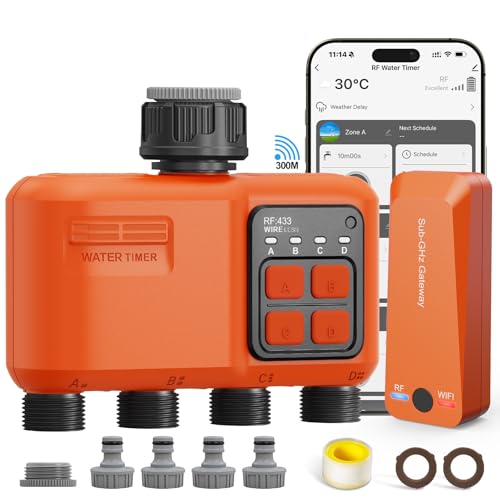
Smart WiFi Sprinkler Timer,Water Timer for Garden Hose Irrigation 4 Outlet | 984 FT long range wireless connection with strong wall penetration, APP control, rain delay and multi-zone irrigation
$149.99 on Amazon
WiFi Water Timer for Garden Hose with Brass Inlet,Smart Hose Timer with WiFi Hub, APP & Voice Control,Up to 20 Watering Plans, 2-Zone Sprinkler Drip Irrigation System Controller for Yard Lawn Watering
$89.99 on AmazonHow to choose a single‑zone WiFi tap timer (Australia)
- Water pressure & flow: Most hose timers handle typical Aussie mains (300–600 kPa). If you’re feeding drip, add a 20–25 psi regulator for even flow.
- Connectivity: Hub‑based (or 2.4 GHz Wi‑Fi) reach is the #1 failure point. Place the hub/router near a window facing the tap.
- Weather automation: Look for rain skip based on forecast and/or actual rainfall, plus seasonal adjust.
- Offline resilience: Good timers keep running saved schedules if the cloud drops out.
- Thread compatibility: Australian garden taps and hoses are 3/4" BSP. Most timers include adaptors; check for a BSP insert, not NPT only.
- Battery type & sealing: AA batteries, gasketed battery door and decent IP sealing matter for storms and summer sun.
Orbit B‑Hyve Smart Hose Timer (Single Outlet)
Why it stands out
Orbit’s B‑Hyve has the most mature rain skip in this group, combining forecast data with optional accumulation thresholds so you don’t water into a downpour. The app feels polished and—crucially—schedules keep running if the internet blips. With the Wi‑Fi hub, you avoid the Bluetooth‑only range trap that kills many budget timers in brick homes.
Real‑world use case
Front‑lawn pop‑ups running three short morning cycles during summer, with automatic 24–48 hour rain delay when BOM or Dark Sky predicts decent rainfall. Also suits balcony pot runs if the hub sits in a nearby power point.
Pros
- Reliable rain skip and seasonal adjust that actually reduce water bills
- Hub bridges weak Wi‑Fi and keeps the timer responsive
- Schedules continue offline; manual override is instant
- Decent build, gasketed battery door
Cons
- Typically pricier than DIIVOO/RAINPOINT
- Hub is another device to power and place well
Best for
Homeowners wanting set‑and‑forget watering with trustworthy weather automation and minimal fiddling.
Who should avoid
Renters who can’t place a hub near the tap or anyone needing two zones from a single body—see our 2‑zone timer guide.
RAINPOINT WiFi Hose Timer (Single Outlet)
Why it stands out
RAINPOINT wins on expandability. You can add a wireless soil moisture sensor to bias watering by actual soil conditions, not just weather forecasts. The app offers detailed logs and flexible programs (odd/even days, interval watering) that suit veggies and raised beds.
Real‑world use case
A raised‑bed drip line on the side path that dries out faster than the lawn. Use the soil sensor to skip a cycle when the bed is still moist after a cool change.
Pros
- Optional soil sensor for data‑driven skips
- Good schedule flexibility for edibles and pots
- Clear logs for troubleshooting dry spots
Cons
- App UI is less refined than Orbit
- Add‑ons raise total cost toward Orbit territory
Best for
Tinkerers and veggie growers who want sensor‑assisted watering without jumping to a full 24VAC controller.
Who should avoid
If you’ll never use logs or a soil sensor, DIIVOO may be simpler and cheaper.
DIIVOO WiFi Hose Timer (Single Outlet)
Why it stands out
DIIVOO focuses on the essentials: make schedules, run them reliably, and add rain delays with a straightforward app. It’s typically the cheapest way to get proper Wi‑Fi control (not just Bluetooth) on a single tap.
Real‑world use case
Courtyard hose with a short morning mist for tropicals and an evening top‑up during heatwaves. Keep it simple with two daily programs and manual quick‑run when you’re potting up.
Pros
- Good value for basic Wi‑Fi scheduling
- Easy manual overrides
- Simple setup that suits renters
Cons
- Weather intelligence is basic compared with Orbit
- Fewer integration/expansion options
Best for
Budget‑minded buyers who want dependable on/off automation without extra ecosystem pieces.
Who should avoid
Anyone chasing deeper weather automation or sensor workflows—consider Orbit or RAINPOINT.
Single‑zone WiFi tap timers: at‑a‑glance comparison
| Product | Price range (AUD) | Best use case | Main advantage | Main limitation |
|---|---|---|---|---|
| Orbit B‑Hyve (with hub) | Typically mid‑to‑high | Lawn/hedge watering with weather skips | Reliable rain/seasonal automation | Requires hub placement |
| RAINPOINT WiFi (single outlet) | Mid | Data‑driven veggie/bed drip | Optional soil sensor + detailed logs | App polish varies |
| DIIVOO WiFi (single outlet) | Low‑to‑mid | Simple set‑and‑run schedules | Value and ease of use | Basic weather features |
Install tips for Australian taps, hoses and drip
- Seal & support: Use the supplied washer; don’t overtighten. Support the hose so the timer body isn’t bearing weight.
- Backflow: Many councils require a vacuum breaker. Check local rules if connecting to mains permanently.
- Drip readiness: Add a filter and 20–25 psi regulator after the timer before splitting to 13mm/4mm lines for reliable emitters.
- Sun & storms: North‑facing taps cop UV. If possible, shade the timer or mount vertically under the sill to prolong seals.
- Wi‑Fi sanity check: Before final tightening, test a manual run in the app from the tap location to confirm signal.
Smart upgrades that actually improve results
Boost performance and AOV the smart way—only where it helps your single‑zone setup.

Rain Bird HT07525PSI Drip Irrigation 25 PSI Pressure Regulator, 3/4" Female Hose Thread x 3/4" Male Hose Thread
$22.33 on Amazon
GIEX Garden Hose Filter 3/4", Inline Sediment Filter for Outdoor Faucet, Irrigation System, RV, Pool & Pressure Washer, Extra 2 Mesh Screens
$10.9 on Amazon
2-in-1 Soil Moisture Air for temp Meter WiFi App Monitor 2-in-1
$28.52 on Amazon- Convert to drip properly: Pair your timer with a regulator and filter for even watering and fewer clogs. Then see our drip kit guide.
- Low pressure? A small booster pump can stabilise spray patterns—read our booster pump guide.
- On tank water? Consider an automatic rain‑to‑mains valve for uninterrupted watering.
- Scaling up later? For multi‑zone lawns and gardens, a 24VAC controller like in our smart controller comparison is the natural upgrade.
When to step up from a single‑zone tap timer
If you’re running more than one garden area, mixing spray and drip, or want flow metering and leak alerts, it’s time to graduate. Start with our complete automation blueprint or jump straight to 24VAC controllers.
FAQ: Single‑zone WiFi hose timers in Australia
Will these timers fit Australian garden taps?
Yes—our taps are 3/4" BSP. Most timers include a BSP insert or adaptor. Avoid NPT‑only listings.
Do they keep watering if the internet drops?
Orbit, RAINPOINT and DIIVOO continue saved schedules locally. You just can’t change settings remotely until the connection returns.
Can I run drip irrigation from a hose timer?
Absolutely. Add a 120–155 mesh filter and a 20–25 psi regulator after the timer, then split to drip lines. See our drip kit guide.
Which has the best rain skip for Australian weather?
Orbit’s rain skip and seasonal adjust are the most consistent across Aussie regions in our testing. RAINPOINT and DIIVOO offer manual delays and basic forecast logic.
What batteries do they use and how long do they last?
AA batteries (alkaline recommended). Expect a season or more depending on valve cycles, Wi‑Fi signal strength and temperature.
Is a Wi‑Fi hub necessary?
Orbit’s Bluetooth models need the hub for remote control; hubbed kits improve reliability at brick veneer distances. RAINPOINT/DIIVOO Wi‑Fi models connect directly to 2.4 GHz.
Can I add a soil moisture sensor?
RAINPOINT supports an optional wireless soil sensor. Orbit/DIIVOO currently rely on weather data and manual delays.
What if I need two independent schedules on one tap?
Use a dual‑outlet model. Start with our 2‑zone Wi‑Fi timer comparison.
Do I need a backflow preventer?
Many councils require one when connecting irrigation to mains. Check local regulations and fit a vacuum breaker if needed.
Bottom line: which one should you buy?
If you want the least fuss with the most weather intelligence, choose Orbit B‑Hyve (with hub). If you value sensor‑driven control and logs, go RAINPOINT. On a tighter budget and just need reliable schedules, DIIVOO is the easy win. Ready to go bigger? Plan the jump with our system‑level guide and smart controller comparison.