
3 Best pH/EC Combo Meters Australia – Stable Nutrients Without Guesswork
Nutrient swings will wreck a crop faster than pests. If your pH and EC aren’t stable, you’ll chase problems—lockout, slow growth, burnt tips—until harvest. The right pH/EC combo meter makes daily checks quick, reliable and repeatable in Aussie conditions from humid QLD summers to WA’s hard water.
Quick Picks
- Best Overall: Bluelab Combo Meter – Trusted accuracy, replaceable probes, built for greenhouse life
- Best Budget: Apera PC60 pH/EC Pen – Fast, simple, IP67 waterproof pocket tester
- Best Premium: Bluelab Guardian Monitor – Always-on reservoir monitoring for zero guesswork
Automating nutrition next? Compare dosing gear in our pH/EC dosing controller guide, and improve water quality with RO systems for hydroponics.
How to choose a pH/EC combo meter (Australia)
- Measurement stability: Look for fast settling and repeatable readings. This matters with high-EC nutrient mixes and warm res temps common in summer.
- Replaceable pH probe: pH electrodes are consumables. Models with replaceable probes cost more upfront but save money long term.
- Water resistance: Splashes happen. IP67 on pens and rugged housings on handheld/bench meters survive real-world use.
- Calibration simplicity: One-touch or guided two-point pH (4.01/7.00) and single-point EC (2.76–2.77 mS/cm) keeps things quick.
- Continuous monitoring vs handheld: Handheld = flexibility across buckets/tents. Continuous monitors = 24/7 visibility and fewer mistakes.
- Australian water: Hard tap water (Perth/Adelaide) starts with high EC; consider RO. Tropical heat (NT/QLD) speeds probe wear—store in KCl.
Best Overall – Bluelab Combo Meter

Bluelab METCOMPLUS Combo Meter Plus for pH, Temperature, and Conductivity in Water and Soil with Easy Calibration, Digital Nutrient (TDS/PPM) Testing Kit for Hydroponic System & Growing Indoor Plants
$454.35 on AmazonWhy it stands out
Built in NZ, the Bluelab Combo Meter nails the basics—accurate pH, EC/ppm and temperature—without drama. Separate, replaceable pH and conductivity probes mean you don’t bin the whole unit when the pH electrode ages. Calibration is quick, readings are stable, and the housing survives greenhouse splashes and nutrient spills.
Real-world use case
If you’re running a medium to large DWC or coco setup and mixing nutrients daily, this meter keeps you consistent. I’ve used it for quick checks across veg and flower reservoirs—stability is excellent, even when the shed hits 35°C in Western Sydney.
Pros
- Replaceable pH probe reduces lifetime cost
- Fast, steady readings in high-EC mixes
- Simple calibration routine with common solutions
- Well-supported in Australia (consumables easy to source)
Cons
- Bulkier than a pocket pen
- No data logging unless you add separate tools
Best for
Growers who want reliable, serviceable gear that lasts through multiple cycles and upgrades.
Who should avoid
If you need continuous, always-on reservoir monitoring at a glance, step up to the Guardian below.
Best Budget – Apera PC60 pH/EC Pen

Apera Instruments PC60 Premium 5-in-1 Waterproof pH/Conductivity/TDS/Salinity/Temp. Multi-Parameter Pocket Tester, Replaceable Probe
$205.69 on AmazonWhy it’s a smart starter
The Apera PC60 balances cost and capability with a compact, IP67 waterproof pen that reads pH, EC/ppm and temperature. It’s quick to stabilise and easy to calibrate. For tents, balconies, and small flood-and-drain or DWC buckets, it’s the pocket tool you’ll actually carry and use.
Where it shines
Daily checks on small reservoirs and quick spot-tests when mixing batches. I’ve found it holds calibration well if you store the pH sensor in KCl and give it a proper clean every few weeks.
Pros
- Fast, simple, genuinely portable
- IP67 waterproof; survives splashes and dunks
- Low cost to get into accurate nutrient control
Cons
- pH sensor is a consumable; expect periodic replacement
- No 24/7 readout; you must measure manually
Best for
Beginners and renters running 1–2 small systems who want dependable readings without a big spend.
Who should avoid
If you frequently overshoot pH or forget checks, a continuous monitor will pay for itself in saved crops.
Best Premium – Bluelab Guardian Monitor
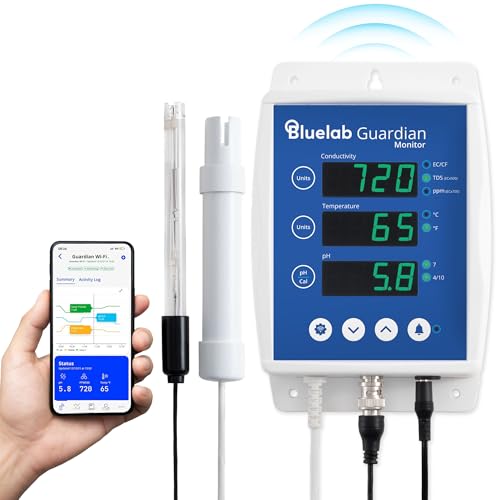
Bluelab Guardian Monitor Wi-Fi for Real-time pH, Temperature, and Conductivity (TDS) Measurements in Water with Calibration, 3 in 1 Digital Nutrient Meter for Hydroponic Systems and Indoor Plant Grow
$627.53 on AmazonWhy it’s worth the upgrade
Set-and-forget visibility. The Guardian sits on your reservoir and shows pH, EC/ppm and temperature 24/7. High/low alarms flag drift before plants suffer. For bigger coco rooms, RDWC, or any setup where you can’t be at the res every hour, this is the stress reducer.
Australian reality
Hot spells drive rapid uptake and pH creep. With a Guardian, you’ll see the trend and correct gently—no wild swings. Pair it with RO in hard-water regions for a rock-solid baseline.
Pros
- Always-on readings reduce human error
- Clear display; alarms stop “silent” nutrient drift
- Long probe leads suit larger reservoirs
Cons
- Fixed installation; not ideal for moving between buckets
- Higher upfront cost vs handhelds
Best for
Committed hobbyists and commercial grows where losing a crop is far pricier than a monitor.
Who should avoid
Micro-grows with tiny tanks that you check once a day—use a pen or handheld instead.
Side-by-side comparison
| Product | Type | Best use case | Main advantage | Main limitation |
|---|---|---|---|---|
| Bluelab Combo Meter | Handheld with replaceable probes | Reliable daily checks across mid–large systems | Serviceable probes, stable readings | Not 24/7 monitoring |
| Apera PC60 | Pocket pen (IP67) | Small tents, buckets, balcony grows | Affordable, truly portable | Manual checks only; probe is consumable |
| Bluelab Guardian Monitor | Continuous reservoir monitor | Large tanks, RDWC, frequent drift | 24/7 visibility with alarms | Fixed install; higher initial cost |
Calibration and care for Aussie conditions
- Calibrate pH monthly using pH 7.00 then pH 4.01. If you run silica or organics, check fortnightly.
- Calibrate EC monthly with 2.76–2.77 mS/cm solution; rinse probes with distilled water between solutions.
- Always store pH probes in KCl, never dry and never in distilled water—prolongs life in hot climates.
- Clean probes after nutrient salt build-up; a gentle probe cleaner prevents sluggish readings.
- Watch tap EC in Perth/Adelaide: starting EC may be too high—RO pays off fast in consistency.
What to add next (small, high-impact upgrades)
- Automate gentle corrections with a peristaltic pH/EC dosing controller.
- Flatten your baseline with reverse osmosis if tap EC is high.
- Stabilise grow-room climate using environmental controllers, dehumidifiers or a mini-split.
Essential maintenance consumables
- pH 4.01 & 7.00 calibration sachets
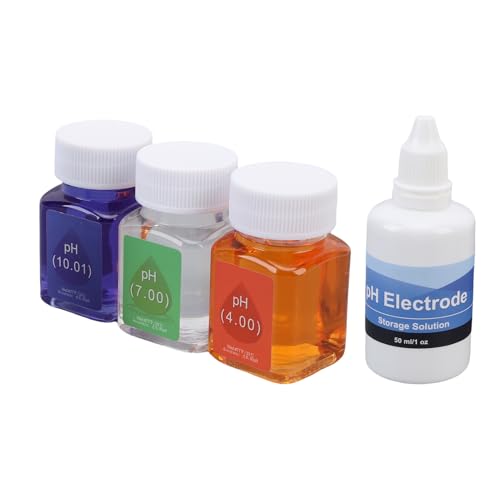
Jectse PH Calibration Solution Kit, 50ML PH 7.00 4.00 10.01 Buffer Solutions with 30ML Probe Protective Liquid, Electrode Storage Solution for Meter
$21.54 on Amazon - 2.76–2.77 mS/cm EC calibration solution

Kactoily EC Calibration Solution Kit (1413 μS/cm, 12.88 mS,111.3 mS/cm) Solution for Aquarium Monitor and Smart Pool Monitor
$47.47 on Amazon - KCl storage solution for pH electrodes

Bluelab STSOL120 KCL Storage Solution 120ml pH Probe and Pen, Maintain Meters Used for Water, Soil, and Hydroponic System or Indoor Plant Grow White
$50.34 on Amazon
FAQs
How often should I calibrate a pH/EC combo meter?
For most hydroponic grows, calibrate pH monthly and EC monthly. If you run hot rooms, organics, or silica, tighten to every 2–3 weeks. Always use fresh solutions and rinse between steps.
Do I need RO water in Australia for accurate readings?
Not always. But hard water areas (Perth, parts of SA) start with high EC and inconsistent alkalinity, making pH control harder. RO gives a stable 0 EC baseline that simplifies nutrient recipes and improves repeatability.
Are replaceable probes worth it?
Yes for anyone growing beyond a couple of cycles. pH electrodes wear; replaceable probes lower lifetime cost and keep your meter in service.
Pen vs handheld meter vs continuous monitor—what should I buy?
Pen for small tanks and portability, handheld with replaceable probes for reliability across multiple systems, continuous monitor for growers who want 24/7 visibility and alarms to prevent drift.
Why do my readings drift during heatwaves?
Higher temperatures speed nutrient uptake and can change solution chemistry. Warm reservoirs also stress roots. Monitor more frequently, keep res temps controlled, and make smaller, more frequent pH adjustments.
How should I store my pH probe?
Keep the glass bulb wet in KCl storage solution between uses. Never store in distilled water or dry—the probe will degrade quickly, especially in warm climates.
What EC should I target for leafy greens vs fruiting crops?
Greens typically run lower EC than fruiting plants. Follow your nutrient line’s Aussie guidelines and adjust gradually based on plant response and runoff measurements.
Can I use aquarium meters for hydroponics?
Some can work, but hydroponic meters are designed for fertiliser salts and frequent calibration. Stick to hydro-specific gear for accuracy and longevity.
Bottom line
If you want fewer issues and tighter growth, buy once for the job you actually do. The Bluelab Combo Meter is the dependable daily driver; the Apera PC60 nails portable value; and the Bluelab Guardian gives you 24/7 peace of mind. When you’re ready to take hands-off control, see our guide to pH/EC dosing automation.