
3 Best Walk-Behind Broadcast Fertiliser Spreaders Australia – Even Coverage for Buffalo & Kikuyu Lawns
Patchy growth, burnt edges along the paths, and wasted granules on the driveway – that’s what a cheap or badly-calibrated spreader does to Aussie lawns. If you’re renovating Buffalo or Kikuyu, or running a seasonal fertiliser program, a dependable walk-behind broadcast spreader is the upgrade that pays for itself in one season. For end-to-end lawn results, see our Australian lawn renovation system guide and pick an aerator from our rolling spike aerator roundup.
Quick Picks
- Best Overall: Earthway walk-behind spreader – consistent metering, sturdy frame, reliable pattern for 400–1000 m² blocks
- Best Budget: Scotts rotary spreader – simple setup and lightweight push feel for smaller Aussie lawns
- Best Premium: VEVOR walk-behind fertiliser spreader – big hopper, heavy-duty build for faster coverage and fewer refills

EarthWay 2600A-Plus 40 LB (18 KG) Walk-Behind Broadcast Fertilizer Spreader, Garden Seeder, Salt Spreader w/9-Inch Pneumatic Wheels, Made in America
$379.24 on Amazon
Scotts Handy Green Fertilizer Spreader
$29 on Amazon
VEVOR Walk-Behind Push Spreader, 50LBS Capacity, Drop Spreader with Hopper Grate, 18 in Spreading Width & 10 Settings, 10 in All Terrain Tires, Garden & Lawn Spreaders for Seed, Fertilizer
$173.9 on AmazonBest Overall – Earthway Walk-Behind Broadcast Spreader
Why it stands out
Earthway’s push spreaders are known for predictable patterns and solid build quality. On real Aussie lawns – from Perth’s sandy soils to humid SEQ – they hold calibration and throw a clean, even swath. Pneumatic tyres smooth out bumps, so you don’t get those heavy/light bands that show up a week after feeding. The hopper and controls feel made for repeat seasonal use, not just a one-off project.
Real-world use case
If you manage a 500–900 m² Buffalo or Kikuyu lawn and apply granular fertiliser 3–4 times a year (plus a wetting agent pass in summer), this is the kind of spreader that makes weekend jobs boringly consistent. It’s also forgiving when you’re edging near pavers – pair it with a deflector and you won’t stain concrete with iron granules.
Pros
- Consistent metering wheel for repeatable settings across different products
- Pneumatic tyres keep the throw even on bumpy, thatchy areas
- Hardware and linkage feel robust for multi-season use
Cons
- Bulkier to store than ultra-compact frames
- Assembly takes a little longer than basic units
Best for
Homeowners serious about a visible upgrade in lawn uniformity on 400–1000 m² blocks; renovation projects where calibration matters.
Who should avoid
Apartment courtyards and postage-stamp lawns – a handheld unit or budget rotary is easier to live with in tight spaces.
Best Budget – Scotts Rotary Spreader
Why it stands out
For small to mid-size Aussie lawns, Scotts’ rotary units keep things simple: light to push, easy to start using, and settings that match common lawn products. If you’ve been broadcasting by hand and want a low-commitment step-up in accuracy without spending big, this is the sweet spot.
Real-world use case
Great fit for 200–500 m² blocks where you fertilise quarterly and want to avoid stripes or hot spots. It’s also a handy second spreader dedicated to pre-emergent or iron – avoiding cross-contamination in your main unit.
Pros
- Lightweight with quick-start settings for popular fertilisers
- Compact to store; easy for anyone in the family to push
- Affordable way to stop guessing and start metering
Cons
- Smaller hopper means more refills on bigger blocks
- Plastic hardware isn’t ideal for rough or frequent pro-level use
Best for
Budget-conscious buyers with smaller lawns, or as a dedicated spreader for specialty products.
Who should avoid
Large suburban or acreage blocks – you’ll appreciate a larger, sturdier build with pneumatic tyres for those.
Best Premium – VEVOR Walk-Behind Fertiliser Spreader
Why it stands out
Step up in capacity and frame strength for faster coverage. If you want fewer refills and a tougher chassis for frequent passes (fertiliser, seed, gypsum, or wetting agents), this heavy-duty style makes short work of bigger areas. The upgrade case is simple: time saved and a smoother pattern at a brisk walking pace.
Real-world use case
Perfect for larger properties, shared equipment in a strata context, or anyone running full spring/autumn renovations. It pairs nicely with a core aerator and dethatcher during a once-a-year overhaul.
Pros
- Large hopper cuts downtime on 800–1500 m² lawns
- Sturdier frame and wheels handle rougher terrain
- Feels planted at pace; spreads evenly without surge
Cons
- Heavier and larger footprint in the shed
- Overkill for compact lawns
Best for
Owners who value speed, durability, and fewer refills during full-lawn feeds and renovations.
Who should avoid
Small-lawn households where storage and manoeuvrability matter more than capacity.
Earthway vs Scotts vs VEVOR – Which one for your lawn?
| Product | Price range (AUD) | Best use case | Main advantage | Main limitation |
|---|---|---|---|---|
| Earthway walk-behind | ~$250–$500 | 400–1000 m² lawns; renovation work | Reliable, even pattern and robust linkage | Bulkier to store |
| Scotts rotary spreader | ~$150–$250 | 200–500 m² smaller lawns | Lightweight, straightforward setup | More refills; lighter-duty hardware |
| VEVOR walk-behind | ~$350–$700 | 800–1500 m² lawns; frequent use | Big hopper, faster coverage | Heavier; needs more storage space |
How to choose a walk-behind broadcast spreader for Australian lawns
- Hopper size vs block size: For typical 400–700 m² suburban blocks, a mid-size hopper keeps refills down. Larger properties justify a premium-capacity unit.
- Tyres: Pneumatic tyres ride better over thatch and uneven turf, keeping the throw pattern consistent. Solid tyres suit flat, manicured lawns.
- Controls & linkage: A smooth, precise gate control makes calibration easy when switching between fertiliser, pre-emergent, and soil amendments.
- Deflector for edges: Essential near pavers and driveways to stop iron stains and runoff into stormwater.
- Coastal corrosion resistance: Stainless hardware or well-finished frames last longer in salty air and humid summers.
- Serviceability: Availability of simple spares (cables, plates, tyres) keeps a good spreader working for years.
Renovating this season? Pair your spreader with a dethatcher or scarifier to open the canopy before feeding: see battery dethatchers or corded scarifiers. For topdressing and smoothing before your spring program, compare our lawn levelling & renovation package ideas.
Calibration and application tips (Buffalo, Kikuyu, Couch)
- Start low, double-pass: Set a lighter feed rate and walk two perpendicular passes. You’ll get more uniform coverage and lower burn risk in summer heat.
- Border pass first: Do a lap around the edge with the deflector on, then fill in the middle at normal throw – protects paths and garden beds.
- Walk speed matters: Keep a steady pace; speeding up thins the spread and ruins consistency.
- Dry day, dry granules: Humidity clumps product and chokes the gate. Store bags sealed and run a quick shake test before loading.
- Rinse and dry: After fertiliser (especially iron), rinse the hopper and linkage; dry before storage to reduce corrosion.
Dial in your program with a soil test before you feed: check our soil test kit guide. Planning a weed-and-feed schedule? Compare by grass type in our spring fertiliser guide.
Optional add-ons that actually help
- Rain cover to keep granules dry between refills
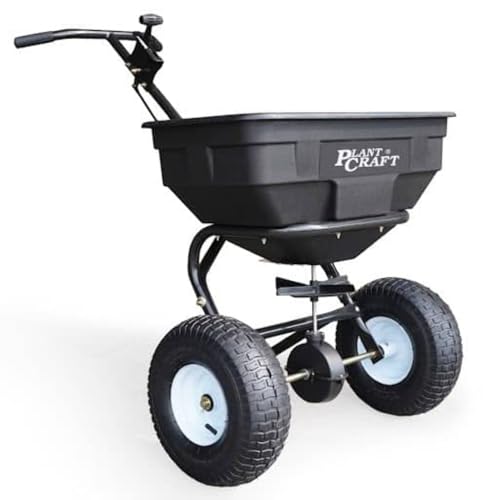
PlantCraft 56kg Walk-Behind Broadcast Spreader
$229 on Amazon - Side-deflector kit for clean edges along pavers

Klanata 49-80-0300 Heat Gun Accessory Kit for Milwaukee, 4-Piece Set with Hook, Deflector, Air Spreader, and Air Reduction Nozzles for Versatile Applications
$42.63 on Amazon - Soil test kit to set the right NPK and application rate

Luster Leaf Rapitest Soil Test Kit
$44.8 on Amazon
FAQs
Is a broadcast spreader better than a drop spreader for Australian lawns?
For most Buffalo, Kikuyu and Couch lawns, a broadcast spreader is faster and delivers a more blended pattern with fewer lines. Choose a drop spreader only when you need tight control along garden edges or very narrow strips.
What hopper size do I need for a 600 m² lawn?
A mid-size hopper is ideal. It reduces refills without making the unit too heavy to push, and keeps application more consistent at a steady walking pace.
How do I avoid staining pavers with fertiliser?
Use a side-deflector when edging and do a border pass first. Immediately blow or sweep any granules off hard surfaces, especially iron-rich fertilisers that can leave rust-coloured marks.
Do I need pneumatic tyres?
They’re worth it on bumpy or thatchy lawns because they smooth the ride and keep the spread pattern even. Solid tyres are fine on very flat, well-groomed turf.
Can I spread wetting agents with the same spreader?
Yes, if they’re granular. Keep a log of settings for each product, and rinse the hopper and linkage after use to prevent build-up.
How often should I calibrate the spreader?
At the start of each season and whenever you change to a new product. Different granule sizes flow differently – a quick catch-test saves money and prevents burn.
What walking speed should I use?
A steady, natural pace – roughly 4–5 km/h. Consistency matters more than speed. If in doubt, do two lighter perpendicular passes.
Will these spreaders handle seed as well as fertiliser?
Yes. Just use a lower setting appropriate to seed size and density, and consider a double-pass to improve coverage.
Bottom line
If your lawn program is moving beyond guesswork, upgrade the tool that decides where every granule lands. Earthway gives you dependable uniformity for typical suburban blocks; Scotts offers a straightforward step-up for smaller lawns; and VEVOR’s heavy-duty build speeds up larger properties. For renovation season, pair your spreader with the right prep tools – start with our plug aerator guide and consider a levelling + scarifier workflow for a truly even surface before feeding.