

Rain Barrel Submersible Pressure Pumps Australia: Best for Garden Hoses & Sprinklers
Running a garden hose or sprinkler from a rain barrel (or slimline tank) needs more than a simple pond pump. You need a submersible pressure pump that can lift water and hold stable pressure so your hose gun, oscillating sprinkler or drip lines work properly. This Australian buyer’s guide explains the key specs that matter, where these pumps fit in a backyard irrigation setup, and highlights three reliable pump styles that suit rain barrels and above-ground tanks.
Quick Picks
- Integrated auto submersible pressure pump (240V): Simple drop-in pump with built-in start/stop controller – great for hoses and a single sprinkler zone.
- High-head submersible multistage pump: Extra pressure for longer hose runs or higher-resistance sprinklers and small multi-outlet setups.
- Compact submersible pressure pump for barrels: Smaller footprint for tight tanks and portable use with hose guns and micro-sprinklers.
At a glance: which pump type suits your setup?
| Product | Type | Integrated Controller | Best suited to | Typical connection |
|---|---|---|---|---|
| Integrated auto submersible pressure pump | Submersible pressure (240V) | Yes (auto start/stop) | Garden hoses, 1 oscillating sprinkler, short runs | 3/4"–1" BSP to garden hose adaptor |
| High-head submersible multistage pump | Submersible multistage (240V) | Often yes (model dependent) | Longer hose runs, higher-resistance sprinklers | 1" BSP to sprinkler/drip manifold |
| Compact submersible pressure pump | Submersible pressure (compact) | Varies (check listing) | Small barrels/tanks, hose guns, micro-sprays | 3/4" BSP to garden hose adaptor |
Primary product picks (Amazon AU)
Integrated auto submersible pressure pump (240V)
Why it stands out: This style drops straight into your barrel or tank and usually includes an internal flow/pressure switch for automatic start/stop when you squeeze the hose trigger. It’s a clean, quiet solution with no priming and minimal plumbing.
Key points to confirm on the product card:
- Submersible pressure pump (not just a dirty-water/drainage pump)
- Auto controller or pressure switch built in
- Suitable outlet thread (commonly 1" or 3/4" BSP) and hose adaptor
- Dry-run protection or thermal protection listed
Practical suitability: Ideal for running a standard garden hose, pistol nozzle or a single oscillating sprinkler from a rain barrel or above-ground tank. Works well with short to moderate hose lengths.
Limitations: Not intended to run multiple high-demand sprinklers at once or long, high-friction pipe runs. Check max head/pressure ratings if you plan to push uphill.
Verdict: The simplest way to power a hose or single sprinkler from a tank, with automatic convenience and low fuss.

Giantz 240V Water Pump Switch Controller Automatic Pressure Irrigation Tool
$42.95 on AmazonHigh-head submersible multistage pump
Why it stands out: Multistage submersible pumps use stacked impellers to deliver higher pressure. Choose this style if you need stronger, steadier pressure for longer hose runs, higher-resistance sprinkler nozzles, or a small multi-outlet manifold.
Key points to confirm on the product card:
- Multistage design (explicitly stated) for increased pressure
- Auto start/stop control included or compatible with an external controller
- Outlet size (often 1") to suit your sprinkler or manifold
- Food-grade or clean-water suitability for rainwater use
Practical suitability: Better where you want firmer spray patterns, rotating/oscillating heads, or modest multi-sprinkler use on short cycles.
Limitations: Higher pressure can expose weak connections. Use proper BSP fittings, thread tape and a filter upstream of fine nozzles.
Verdict: A strong choice when you’ve outgrown a basic barrel pump and want more headroom for sprinklers.
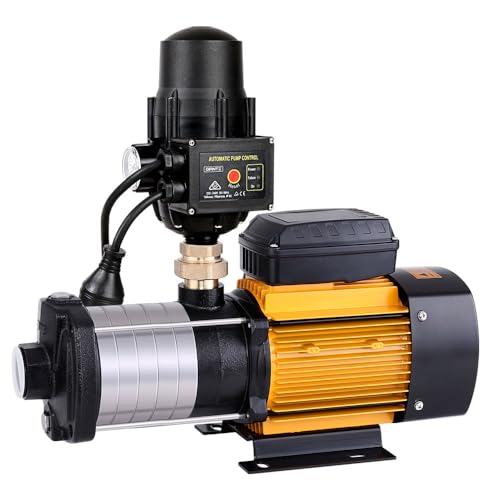
Giantz 2500W 6-Stage Garden Water Pump High Pressure Irrigation Booster
$265 on AmazonCompact submersible pressure pump for barrels
Why it stands out: When space is tight or you want an easier lift-in/lift-out option, compact submersible pressure pumps fit narrow barrels and still maintain useful hose pressure for hand watering or micro-sprays.
Key points to confirm on the product card:
- Pressure-rated submersible pump (not a low-head utility/pond pump)
- Compatible outlet thread and included hose adaptor
- Float switch or low-water protection (helps protect the pump)
Practical suitability: Great for portable watering around small gardens, patios and courtyards, especially with hose guns and small sprinklers.
Limitations: Less suited to running multiple full-size sprinklers. Always check pressure/head ratings against your sprinkler’s minimum requirement.
Verdict: A handy, space-saving option that upgrades a simple rain barrel into a pressurised hose supply.

NovAbyss 55W Submersible Water Pump, Up to 3000 L/H, 3m Max Head, 3 Nozzles
$34.99 on AmazonHow to choose the right submersible pressure pump
1) Pressure and head vs what you’re running
- Hose guns and basic oscillating sprinklers need modest, steady pressure. A single integrated auto submersible pump often suffices.
- Rotary/impact sprinklers or longer hose runs benefit from a higher-head (multistage) pump.
- Drip/micro spray is sensitive to pressure consistency. Use a pump capable of holding stable output and add a pressure regulator at the zone.
2) Built-in controller vs external controller
- Built-in (auto start/stop): Simplest for hoses. Starts when flow is demanded, stops when the tap closes.
- External controller: Useful if your chosen pump doesn’t include control, or you want extra features (restart logic, dry-run trips).
For full rain-to-mains or multi-zone automation, see our Australian deep-dive on rainwater tank irrigation automation and pump controllers.
3) Filtration and water quality
Rainwater is generally clean but can carry fine sediment. Add a sediment filter upstream of sprinklers/drip to protect nozzles and maintain patterns. For drip irrigation layouts, start with the guidance in drip filter/regulator kits and raised bed drip kits.
4) Connections and adaptors
- Most pumps use BSP outlets (commonly 1" or 3/4").
- Use a brass/plastic BSP-to-garden-hose adaptor and thread tape.
- Keep hose runs sensible to limit friction loss and preserve pressure.
5) Safety and protection
- Dry-run protection prevents damage when the tank runs low.
- Float switches are helpful for barrel applications.
- Use a GPO with RCD protection and follow the manufacturer’s installation guidance.
Setups that work in Aussie backyards
- Hose-first system: Integrated auto submersible pump in a barrel, 3/4" adaptor to a 20–30 m garden hose, and a quality hose nozzle. For lawns, match with a water-efficient sprinkler from our oscillating sprinkler guide.
- Sprinkler-ready tank: Higher-head multistage submersible feeding a short header hose, on/off via hose tap timer (see Wi‑Fi tap timers or 2‑outlet timers), then a sprinkler or micro-spray zone with a regulator.
- Automation path: If you later add zones, filters and a smart controller, refer to complete irrigation automation and 24VAC smart controllers.
Common mistakes to avoid
- Buying a drainage/dirty-water pump expecting sprinkler performance. Those are high-flow, low-pressure.
- Skipping filtration on drip/micro. Clogged emitters waste time and water.
- Undersizing hose fittings creating pressure loss. Match outlet threads and keep adaptors minimal.
- Overstretching a compact pump with multiple large sprinklers. Step up to a multistage submersible instead.
Related guides
- Irrigation booster pumps
- Solar irrigation pump kits
- Rain-to-mains changeover valves
- Submersible dirty-water pumps (what they’re for)
- Smart drip from a rain tank: filters, pump, controller
FAQ
Will a submersible pressure pump run an oscillating lawn sprinkler?
Yes—provided the pump is pressure‑rated and meets the sprinkler’s minimum pressure requirement. An integrated auto submersible pump typically handles one oscillating sprinkler on a reasonable hose length; for stiffer nozzles or longer runs, use a higher‑head multistage submersible.
How do I connect the pump to a standard garden hose?
Most pumps have 3/4" or 1" BSP outlets. Use a suitable BSP‑to‑hose adaptor (brass or reinforced plastic) with thread tape, then attach your hose coupling as usual.
Do I need a controller?
If the pump has a built‑in auto start/stop controller, no extra controller is required for hose use. If not, add an external pump controller for protection and convenience, especially on automated zones.
What about filters?
Add a sediment filter ahead of sprinklers and drip gear to protect nozzles. This is particularly important for micro‑irrigation. See our filter/regulator kit guide.
Can I automate a rain‑barrel pump with a tap timer?
Yes. Pair the pump (with auto controller) to a hose tap timer placed downstream. The timer opens, water flows, the pump senses demand and starts. For multi‑zone systems, step up to a smart controller and consider a higher‑head pump.
What if my tank is far from the garden?
Distance and elevation increase pressure loss. Choose a multistage submersible with higher head, use larger‑diameter supply hose/pipe where possible, and keep fittings simple to reduce friction.