
Best Tow-Behind Fertiliser Spreaders Australia (Ride-On Mowers)
Spreading lawn fertiliser evenly over larger Aussie blocks can chew up half your weekend if you’re walking. A tow-behind spreader hooked to your ride-on lets you cover big areas quickly, keep application rates consistent, and avoid stripes or burn.
Quick Picks
- Best Overall: Agri-Fab 130 lb tow-behind broadcast spreader — proven large-capacity hopper and wide, even pattern for Aussie lawns
- Best Value: VEVOR tow-behind broadcast spreader — practical mid-size capacity at a sharp price for quarter-acre blocks
- Best Premium/Heavy-Duty: Brinly tow-behind broadcast spreader — robust build and smooth metering for repeat seasonal use
If you’re planning a full lawn renovation, see how this slot into your program alongside aeration and dethatching in our Australian lawn renovation system guide. For pairing with aeration passes, compare tow-behind plug aerators and rolling spike aerators.
At a glance: how we chose
- AU suitability: Pin-hitch compatibility with common ride-on mowers, parts availability, and Amazon Australia listing depth
- Coverage & control: Even broadcast pattern, usable flow control, and agitation to reduce bridging
- Durability: Poly hoppers, corrosion resistance, protected gearboxes and practical tyres for rougher Aussie turf
- Commercial value: Models that convert well and deliver real time-saving upgrades for ride-on owners
Comparison
| Product | Best use case | Main advantage | Main limitation | Power source |
|---|---|---|---|---|
| Agri-Fab 130 lb tow-behind broadcast spreader | Large Aussie lawns and frequent feeding | High-capacity hopper with wide, consistent spread | Bulkier to store; overkill for very small yards | Ground-driven |
| VEVOR tow-behind broadcast spreader | Value-focused owners with medium yards | Practical capacity at a sharp price | Less refined controls vs premium brands | Ground-driven |
| Brinly tow-behind broadcast spreader | Heavy seasonal use and renovation work | Sturdier build and smooth metering | Higher upfront cost | Ground-driven |
Best Overall — Agri-Fab 130 lb Tow-Behind Broadcast Spreader
For most Australian ride-on owners, this Agri-Fab strikes the right balance of capacity, spread consistency and durability. It’s a popular choice for quarterly feeds, pre-emergent applications, and renovation programs where you need to meter product reliably without constant refills.

Agri-Fab 45-0463 130-Pound Tow Behind Broadcast Spreader, Black
$459.1 on AmazonWhy it stands out
- Time saver for bigger blocks: A larger hopper reduces refill stops, especially handy on 1/4–1 acre lawns.
- Even coverage: A broad broadcast pattern helps avoid stripes or patchy colour.
- Ride-on friendly: Pin-hitch connection suits most Aussie ride-ons and garden tractors.
- Durability focus: Poly hopper and enclosed drive reduce rust risks in coastal or humid regions.
Tip: Set the flow gate conservatively on your first pass, then fine-tune with a catch test (see calibration notes below) to dial in your target g/m².
Best Value — VEVOR Tow-Behind Broadcast Spreader
If you want a capable tow-behind at a friendlier price, this VEVOR model covers mid-size Aussie lawns efficiently. It’s practical for standard fertiliser granules and lawn products where you need predictable output without going premium.
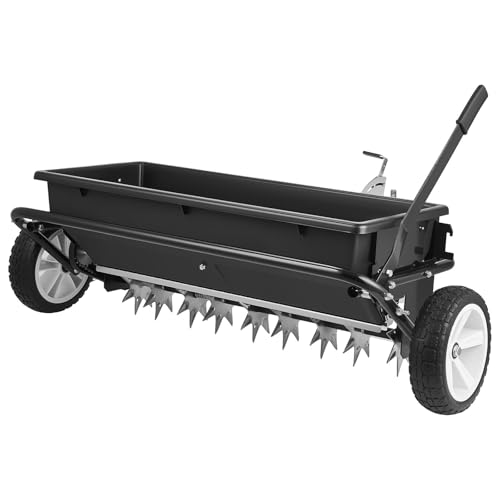
VEVOR Tow Behind Lawn Spreader with Aeration Spikes, 0.81m Spreading Width, Broadcast Spreader with Universal Hitch, Garden Seeder & Soil Aerator with 100lbs Capacity & 10 in Tires for ATVs UTVs
$493.9 on AmazonWhy it stands out
- Solid capacity for suburbs: Ideal for common 600–1200 m² lawns without constant refilling.
- Value-led build: Straightforward controls and a ground-driven impeller keep things simple.
- Easy attach: Standard pin hitch suits most ride-on mower drawbars.
Consider adding a hopper cover if you often spread early morning in dew; it helps keep prills flowing.
Best Premium/Heavy-Duty — Brinly Tow-Behind Broadcast Spreader
Brinly is well-regarded for robust lawn attachments. This tow-behind spreader is a smart pick if you run multiple seasonal applications, topdress with amendments, or want a smoother metering action for precise rates during renovations.
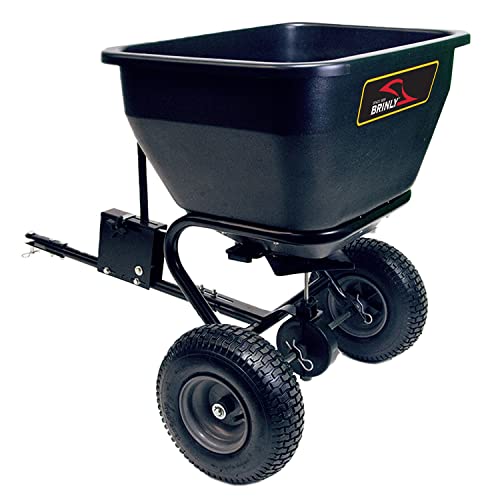
Brinly BS36BH-A Tow Behind Broadcast Spreader with Universal Hitch, 175 lb.+
$523.64 on AmazonWhy it stands out
- Built to last: Sturdier frame and protected gearing for frequent use.
- Smoother metering: Helpful when spreading pre-emergent or fine prills that need consistent flow.
- Renovation-friendly: Pairs well with plug aeration and dethatching in full lawn refresh cycles.
Plan storage with tyres off the ground where possible to prevent flat spots if it sits all winter.
Tow-behind vs walk-behind spreaders
- Covers more, faster: Tow-behind spreaders shine once you’re handling bigger blocks or frequent seasonal feeds.
- Less fatigue: Let the ride-on do the work; your pace stays steady which improves application consistency.
- Still own a smaller patch? A walk-behind may be simpler. Compare picks in our walk-behind spreader guide or our size-based roundup for 400–1000 m² lawns.
Buying guide: what actually matters
1) Hopper size and refills
Bigger hoppers cut refill time but need more storage space. Choose capacity based on your lawn size and how often you spread. For large yards or multiple seasonal apps, a higher-capacity unit pays off in time saved.
2) Evenness of spread
A steady broadcast pattern is the difference between a lush, uniform lawn and stripes. Look for consistent left/right throw and an agitator to reduce bridging of granules.
3) Flow control and calibration
Simple, repeatable settings help you hit label rates. Mark down the gate setting you land on for each product so future applications are plug-and-play.
4) Drive and gearbox protection
Enclosed, ground-driven gearboxes resist corrosion and grit. This matters in coastal areas and for long-term reliability.
5) Tyres and terrain
Pneumatic tyres ride smoother on bumpy kikuyu or buffalo lawns and help maintain an even spread pattern at a steady tow speed.
6) Build and corrosion resistance
Poly hoppers and coated frames minimise rust. Rinse after use, especially with nitrogen or iron products.
7) Hitch fitment
Most ride-ons use a pin hitch. Check your drawbar height and ensure the spreader tows level so the pattern stays even.
Calibration and application tips
- Do a quick catch test: With the spreader stationary, catch product from the chute over a timed gate opening to estimate output. Adjust the gate to get close to the label rate.
- Start light, overlap lightly: Two lighter passes at 90° often beat one heavy pass for uniform colour.
- Keep a steady pace: Use a consistent tow speed; surging changes your application rate.
- Dry granules flow best: Moist product bridges more; an agitator helps but avoid spreading in heavy dew if possible.
- Clean thoroughly: Rinse hopper and undercarriage after use; let it dry before storage.
Pair your spreader with the right prep work. If the lawn is spongy or compacted, dethatching and aeration can dramatically improve fertiliser response. Compare options in our battery dethatcher guide or see corded scarifiers.
Safety
- Follow the fertiliser label for personal protective equipment and application rates.
- Avoid slopes that exceed your ride-on’s safe operating advice; slow down for uneven ground.
- Keep granules away from drains, pools and paved areas. Sweep up any spills.
- Always follow the manufacturer’s instructions for assembly, towing speed and maintenance.
Related gear to complete your lawn upgrade
- Tow-behind lawn sweepers to clear leaf litter before spreading.
- Complete lawn leveling & renovation package for topdressing after feeding.
- Weed & feed timing by grass type to match product to buffalo, couch or kikuyu.
FAQs
Will a tow-behind spreader fit my ride-on mower?
Most use a standard pin hitch. Check your mower’s drawbar height and ensure the spreader tows level. If needed, use washers or a simple hitch plate to fine-tune height.
What capacity should I choose for an Australian suburban block?
For medium yards, a mid-size hopper reduces refills and keeps storage manageable. Larger acreages benefit from higher capacity to finish in one go.
Can I spread lime, gypsum or wetting agent granules?
Granular products usually spread well. Very fine powders can bridge; an agitator helps, but follow label guidance. Avoid wet product and store bags dry.
How do I avoid stripes or patchy colour?
Calibrate first, run two lighter passes in a crisscross pattern, and keep a steady tow speed. Slight overlaps are better than gaps.
Do I need a deflector shield?
Useful along garden beds or hard edges to keep prills off paving. If not included, you can switch to perimeter passes at a reduced flow to control throw.
What speed should I tow at?
Follow the manufacturer’s guidance. A steady walking-pace equivalent is typical; faster speeds change output and the throw pattern.
How do I clean and store the spreader?
Rinse the hopper, impeller area and frame after each use. Let dry fully. Store under cover; keeping tyres off the ground helps prevent flat spots.
Is stainless hardware worth it near the coast?
Yes. Corrosion-resistant fasteners and an enclosed gearbox pay off in salty or humid climates. Rinse after use and dry thoroughly.
Bottom line
For most Aussie ride-on owners, the Agri-Fab 130 lb model offers the best mix of capacity, coverage and reliability. Value hunters can start with the VEVOR, while frequent users who prioritise build quality should shortlist Brinly. Choose a size that matches your lawn, calibrate once, and you’ll get faster, cleaner, more consistent results every season.